Core calculators
North Node Calculator
Find your north node with our North Node Calculator. Explore growth direction and life-purpose themes in plain, practical language.
Free calculator
North Node Calculator
Enter your birth details to find your North Node sign and placement.
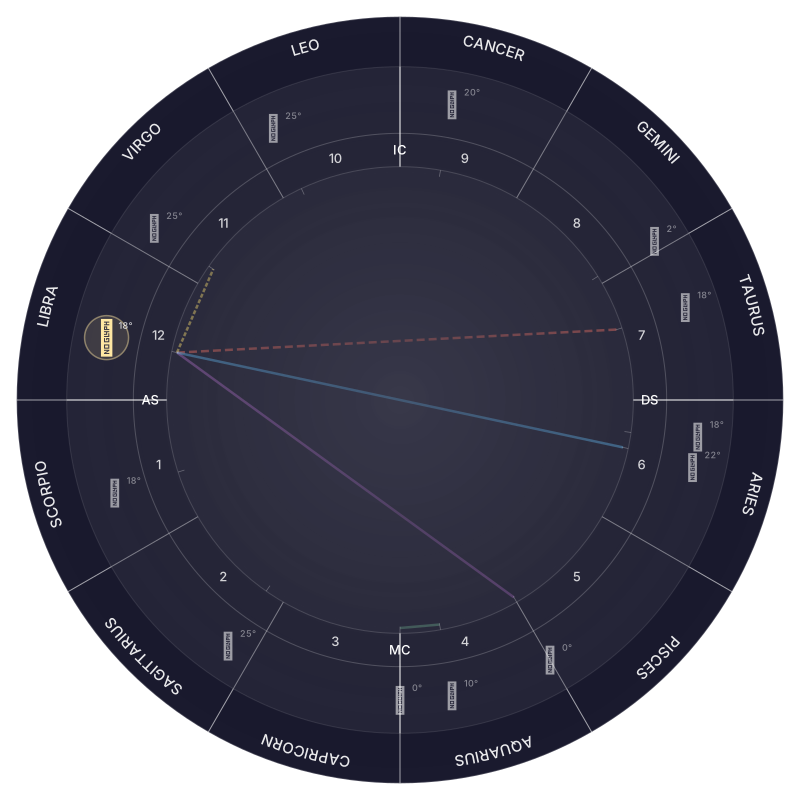
What this calculator shows
A North Node Calculator locates the zodiac sign—and ideally the degree and house—of your growth-oriented lunar node at birth. That point is treated as a compass toward skills and attitudes that may feel less automatic yet more expansive over a lifetime. It is not a planet you can photograph; it is a calculated intersection of orbital planes.
Because nodes move slowly—completing a cycle in roughly eighteen and a half years—entire birth cohorts share a nodal sign axis. Personal uniqueness arrives through house placement, aspects, and how your Sun, Moon, and angles speak to that axis. The calculator’s job is to name your placement clearly so interpretation can begin from fact rather than guesswork.
This page is a realistic short-term ranking target: the query is specific, the audience is engaged, and the topic pairs naturally with a dedicated south node page through internal links. We treat them as always-linked companions rather than isolated curiosities.
How to use your result
Enter birth data carefully. When the tool ships, expect sign and degree of the growth point, plus house cusps if birth time is present. Write down the opposite sign as well—even before you open the paired page—because the axis is one story with two poles.
Ask developmental questions instead of identity labels. What behaviors feel awkward but rewarding when you practice them? Where do you over-rely on comfort patterns that once kept you safe? Growth work often feels like purposeful stretching rather than instant mastery.
Compare the placement with Saturn timing during major decades. A saturn return can press someone to practice stretch skills with more seriousness because temporary coping strategies stop scaling. Pair the growth edge with moon sign habits too—emotional defaults often explain why the stretch feels costly. Linking those tools keeps growth language grounded in time.
What growth symbolism emphasizes
Sign flavor describes the style of stretch. An earth placement may invite embodiment, craft, and stewardship. Air growth may emphasize communication networks and perspective-taking. Fire invites courageous authorship; water invites emotional honesty and regenerative care.
House topics localize the classroom: relationships, vocation, learning, solitude, community. A relationship-house stretch will not look like a career-house stretch even when both share a sign. That is why a natal chart context remains essential.
Aspects from personal planets can accelerate or complicate the story. A conjunction from Venus or Mars makes nodal themes vivid in desire and action. Squares create friction that can become motivation. Soft aspects may show natural helpers if you consciously use them toward growth rather than comfort alone.
Misconceptions to avoid
The growth pole is not “good” while the familiar pole is “bad.” Comfort carries talent and memory; the problem is getting stuck there. Stretch carries expansion; the problem is forcing it without patience. Integration beats purity narratives.
Another misconception: knowing the sign alone completes the reading. Without house and aspect context, advice stays generic. Use this calculator as a precise starting coordinate, then deepen with full-chart study.
Finally, nodes are not a substitute for mental health care or practical planning. Symbolic growth language works best beside real-world supports.
Pair this page with the familiar pole
Whenever you discuss your north node with friends or students, name the south node in the same breath. Our companion calculator exists so both keyword variants have a home without duplicating entire essays. Cross-links on both pages use descriptive anchors so authority flows between them.
From there, return to the natal wheel for houses and aspects, or explore monthly and multi-year timing tools when you want to know when nodal themes get louder in lived experience.
Practice for ordinary weeks
Pick one stretch behavior you can practice in under twenty minutes this week. Large destiny language fails when it never becomes a calendar block. Write the experiment in concrete verbs: send the draft, ask for help, take the walk, open the hard conversation.
Tell a trusted person what growth edge you are trying on. Accountability that is kind beats secrecy that turns into shame when you slip. Ask them to notice effort, not perfection.
Notice envy as a compass: sometimes envy points toward qualities you have not authorized yourself to develop. Interrogate it without stealing someone else’s path. Ask what tiny version of that quality you could practice without impersonating them.
If Saturn is active in your life, expect practice to feel heavier and more consequential. That weight can be clarifying rather than cruel—especially when you track which old strategy stopped scaling.
Return to the familiar-pole page whenever you catch yourself mocking the growth edge. Mockery often protects an overused comfort pattern. Naming that defense softens it.
Building a personal growth dossier
Create a one-page dossier with four fields: sign style, house classroom, hardest aspect, and a current micro-experiment. Update it quarterly. The dossier keeps interpretation from dissolving into vague inspiration quotes.
When birth time improves—new record found, rectification done—rebuild house context before rewriting your whole story. A sign-level stretch can sit in a different life area once houses stabilize, and that shift often explains why older advice felt slightly off.
Study cohorts carefully. Sharing a nodal generation axis with millions of people does not erase uniqueness; it clarifies which parts of your story are personal (house, aspects, culture) versus generational climate. Teach that distinction when you explain results to friends.
If north node astrology language ever starts sounding like a moral scoreboard, pause and return to experiments you can finish this week. Moralizing freezes action; scheduling restores it.
Frequently asked questions
What is my North Node?
It is one of the two lunar nodes: points where the Moon's orbit crosses the Sun's apparent path, the ecliptic. In north node astrology, that placement is often read as a growth direction or life area you are learning to develop.
How do I find this growth point?
Use a North Node Calculator with your birth date, birth time if known, and birthplace. The tool can show sign, degree, and, when the birth time is accurate, the house placement too.
What house holds this placement?
The house depends on your exact birth time and location because houses are anchored to the Ascendant. Without birth time, a calculator can often estimate the sign, but the house may not be reliable.
How does it differ from the familiar pole?
The two lunar nodes are opposite ends of the same axis. This growth point is commonly interpreted as development and unfamiliar territory, while the opposite pole describes familiar patterns, natural habits, or qualities that may need to be balanced.
What does it mean in astrology?
It points toward qualities and experiences that support growth. It is not a planet; it is a calculated point, so it is usually interpreted together with its opposite, plus the signs and houses involved.
Related calculators
Continue with tools that pair well with north node calculator.
- south nodeFind your south node and how familiar habits and gifts show up in practice.
- natal chartMap your free birth chart and natal chart from birth date, time, and place.
- saturn returnFind your saturn return dates and see when your next maturation window begins.
- moon signFind your lunar placement and emotional temperament from birth details.