Core calculators
Birth Chart Calculator
Use our Birth Chart Calculator to map your natal chart from birth date, time, and place. Learn how to read the result clearly.
Free calculator
Birth Chart Calculator
Enter your birth date, time, and place. You'll be taken to your natal chart results after we calculate the sky for that moment.
What this calculator shows
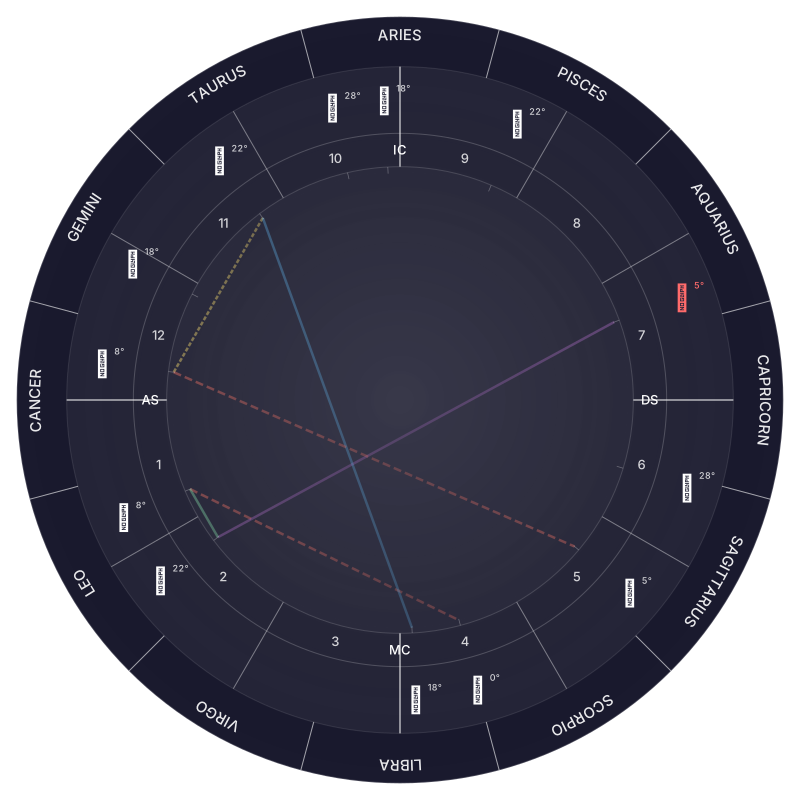
A Birth Chart Calculator turns three quiet facts—your birth date, birth time, and birth place—into a sky map for the exact moment you arrived. Astrologers call that map a natal chart or birth chart. It is not a daily horoscope that changes by sun sign alone. It is a freeze-frame of the planets, the Moon, and the local angles as seen from Earth at your first breath.
When people search for a free birth chart, they usually want two things at once: the visual wheel and a plain-language start on how to read it. The calculator answers the first need by computing planetary longitudes and house cusps. The explanatory copy on this page answers the second by showing what the result means and how to use it without drowning in jargon.
Treat the natal map as a lifelong reference, not a one-time parlor trick. The sky moves on, but your placements stay fixed. Later tools—such as a lunar return chart or a saturn return timing window—only make sense against that baseline. That is why this page sits as a long-term authority page in our calculator cluster rather than a quick keyword stub.
How to use the calculator once it launches
Enter your birth date first. Many people know that piece with certainty. Then add birth time as precisely as records allow—hospital notes, family Bible entries, or an official certificate beat a vague “around dinner.” Minutes matter for the Ascendant and house cusps, which can shift signs quickly.
Choose the birth city carefully. Modern calculators convert the place into latitude, longitude, and historical timezone offsets. If you were born in a small town that has merged into a larger metro area, search for the name used at the time or the closest known coordinates. Wrong place data quietly skews houses even when planetary signs look fine.
After you submit the form, read the output in layers. Note sign placements for the Sun, Moon, and personal planets. Then check which house each planet occupies if you have a reliable time. Finally, scan major aspects—conjunctions, squares, trines, oppositions—that link planets into themes. Save or screenshot the result so you can compare it later with predictive charts.
What the result means in practice
Your natal chart does not assign a single fate sentence. It describes tendencies, tempos, and tensions. The Sun shows core vitality and identity style. The Moon describes emotional needs and instinctive responses. Rising sign colors how others first meet you and how you approach new situations. Together they form the “big three” many people recognize before they study anything else.
Personal planets—Mercury, Venus, Mars—speak to thinking style, relating style, and drive. Outer planets describe generational climate, while their house and aspect connections to your personal planets show where that climate becomes personal. The north node and its opposite sketch growth direction and familiar habits; they pair naturally with dedicated node pages once you know your natal degrees.
Houses localize topics: money, career, partnership, creativity, health routines, and more. Without birth time, house meanings stay speculative. With birth time, a planet in the tenth house can talk about public role while the same planet in the fourth leans toward home and roots. That localization is why serious natal work starts with verified birth data whenever possible.
Common misconceptions about free charts
A free map is not incomplete just because it is free. Completeness depends on astronomy and timezone math, not on whether someone charged you. What often differs is interpretation length. A short overview helps orientation; a full professional report expands symbolism across every placement.
Another myth is that sun-sign horoscopes already give you a natal wheel. They do not. Millions of people share a Sun sign while living with radically different Moons, Rising signs, and aspect patterns. Using only the Sun is like judging a city by its skyline photo while ignoring the streets.
People also assume an approximate birth time is “close enough.” Sometimes it is for rough planetary signs. It fails for angles and houses. If your certificate lists 2:00 p.m. but relatives swear it was nearer 4:00, consider chart rectification with a skilled astrologer before making house-heavy decisions.
How this page relates to other calculators
Once you have a natal chart, specialized tools become useful. A moon sign calculator isolates emotional tone if you only need that piece quickly. A Saturn timing tool estimates when Saturn returns to its natal degree—roughly every twenty-nine years—for maturity and structural life chapters. A monthly Moon map builds a short-term sky when the Moon returns to its natal place.
Your nodal markers sit inside the same natal foundation. Studying them after you can find your nodes keeps the conversation coherent. Internal links on this page point to those related calculators so you can move from baseline map to timing and focus tools without scattering near-duplicate thin pages across the site.
We keep secondary phrases such as birth chart, natal chart, and free birth chart woven through this guide because they describe the same underlying tool from different search angles. Ranking one strong page for those related intents is more durable than spinning separate stubs that compete with each other.
A reading order that prevents overwhelm
Start with the big three, then personal planets, then the house of the Moon and Saturn. That sequence gives most newcomers a usable story without dumping every outer-planet aspect on day one. Save progressions and returns until the natal baseline feels familiar.
Create a one-page summary in your own words: what restores you, how you approach conflict, what you notice first in new rooms, and where commitment pressure tends to land. Plain language is a feature; jargon is optional seasoning.
When friends ask for a reading, refuse to skip birth time caveats. Teaching data hygiene is part of ethical chart culture and prevents house myths from hardening into identity.
If you study predictive techniques later, always name which natal points a transit is activating. Timing without a host map becomes astrology theater. This calculator exists so the host map is never a mystery.
Revisit the saved wheel after major life chapters—moves, titles, caregivers—not because placements change, but because you will notice different lines in the same document. Literacy grows with experience.
Frequently asked questions
How do I calculate my birth chart?
Use a Birth Chart Calculator and enter your birth date, birth time, and birthplace. The tool uses that information to build your natal map, showing where the Sun, Moon, planets, and houses were at the moment you were born.
What information do I need for an accurate map?
For the most accurate result, you need your date of birth, exact birth time, and birth location. Birth time matters most for the rising sign, house placements, and chart angles; if the time is unknown, a free birth chart can still show many planet signs, but the houses may be approximate.
What is the difference between a birth chart and a natal chart?
There is no real difference. A birth chart and a natal chart are two names for the same astrology map: a snapshot of the sky at your exact birth moment.
Does a calculator show houses and planets?
A full tool usually shows the planets, zodiac signs, houses, aspects, and major points like the Ascendant. Some simpler tools only show the Sun, Moon, and rising sign, so choose one that offers a complete natal chart if you want houses and planets.
Is a free tool accurate?
A free calculator can be accurate when it uses reliable astronomical data and you enter the correct birth details. The biggest source of error is usually an estimated or missing birth time, because that can change the Ascendant and house placements.
Related calculators
Continue with tools that pair well with birth chart calculator.
- moon signFind your lunar placement and emotional temperament from birth details.
- north nodeLocate your north node and explore growth themes without destiny hype.
- saturn returnFind your saturn return dates and see when your next maturation window begins.
- lunar returnCast a monthly Moon map when the Moon returns to its natal place.